
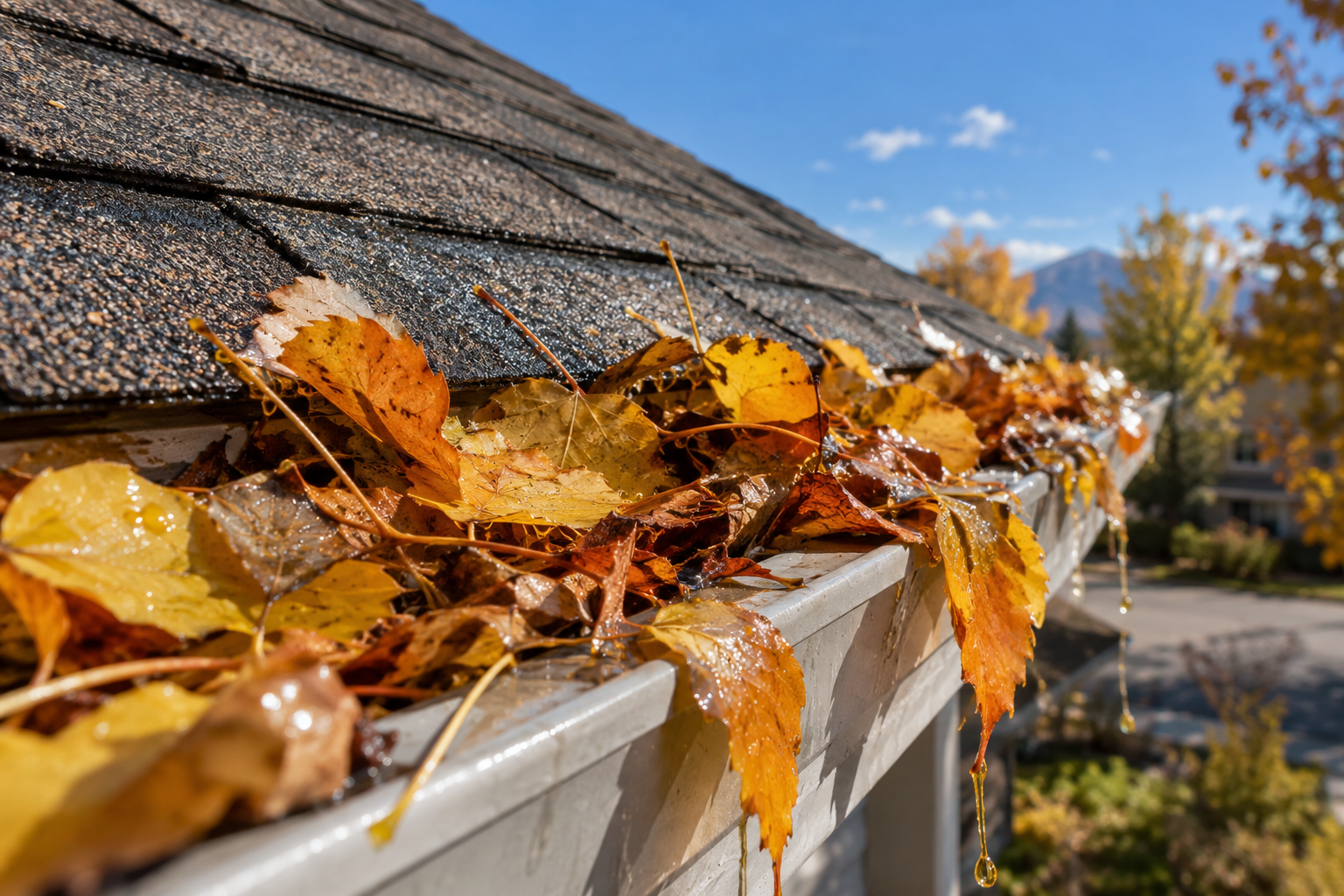
Any week now, the cottonwoods and ash trees across Brighton and the rest of the Front Range will put on their show, and then drop the whole performance straight onto our roofs. Most homeowners rake the yard and call fall done. But understanding how falling leaves damage your roof, quietly and mostly out of sight, is what separates an easy winter from a February leak.
This post zooms in on one piece of fall prep that gets skipped the most: leaves and the gutters they clog. For the broader seasonal rundown, keep our fall roof maintenance checklist handy too.
How Do Falling Leaves Damage Your Roof?
A few leaves skittering across the shingles are harmless. The trouble starts when they accumulate, especially in roof valleys, behind chimneys, and around skylights, where wind piles them into wet mats after the first rain or snow.
Those mats hold moisture against your shingles for weeks. Trapped moisture accelerates granule loss, feeds moss and algae, and keeps the roof surface from drying out between storms. On an older roof, a soggy leaf pile sitting in a valley all fall is a leak getting a head start.
And of course, most of those leaves don’t stay on the roof. They slide into the gutters, which is where the real damage begins.
What Do Clogged Gutters Do to a Colorado Roof?
Gutters have one job: move water off the roof and away from the house. When leaves pack them full, water overflows the edges instead. It soaks the fascia boards and soffits, wicks backward under the bottom row of shingles, and dumps right at your foundation.
Don’t forget the downspouts in this picture. A clog at the downspout outlet backs up the entire run, and even a clean gutter does little good if the downspout dumps water right at the slab. Extensions that carry runoff a few feet away from the foundation are some of the cheapest protection your house can buy.
Clogged gutters also get heavy. Wet leaves weigh far more than people expect, and when that load freezes solid, it strains the hangers and can pull the entire gutter run away from the fascia. We see gutters sagging off Adams County homes every spring that were fine in September.
Why Does This Get Worse Once Temperatures Drop?
Along the Front Range, the first hard freeze usually arrives in early to mid October, and from there Colorado runs its famous freeze-thaw cycle almost daily. Water trapped in a clogged gutter freezes at night, expands, and pries at seams and joints. Melt off the roof hits the ice blockage, backs up, and refreezes higher.
That’s how ice dams form at the eaves. Once meltwater pools behind an ice dam, it can push up under the shingles and into the roof deck, and that’s when you see ceiling stains in January. Attic ventilation plays a big role here too; if your roof melts snow unevenly, our Colorado roof ventilation guide explains why.
When Should I Clean My Gutters in Colorado?
If your property has mature trees, plan on twice each fall: once mid-drop, and once after the branches are bare but before the first big snow. For most of the Front Range, that second pass lands in late October or early November.
If you only do it once, do it late, after the leaves are down. A pristine gutter cleaned in September can be packed again by Halloween. Homes with pines are a special case, since needles shed year-round and slip past most guards.
While you’re at it, clear the roof surface too. A leaf blower or a soft brush on an extension pole will move leaf piles out of the valleys without disturbing the granules. Skip the pressure washer; it strips more life off your shingles than the leaves ever would.
What Are the Signs My Gutters Are Already Causing Trouble?
You don’t need a ladder to spot most of the warning signs. From the ground, watch for:
- Water sheeting over the gutter edges during a rainstorm
- Gutters visibly sagging or pulling away from the fascia
- Peeling paint, rot, or dark streaks on the fascia boards or siding below the gutter line
- Shingle granules and debris collecting at downspout outlets
- Plants or seedlings actually sprouting from the gutter (yes, it happens)
- Pooling water at the foundation, or a damp basement after storms
- Ice dams or oversized icicles at the eaves last winter
Any one of these means the water isn’t going where it should, and the fix is a lot cheaper now than after a freeze.
Should I Clean My Gutters Myself or Call a Pro?
For a single-story home with a sturdy ladder and a helper to foot it, cleaning gutters is a reasonable DIY job. Work from the ladder, not the roof, and never lean out past your hips.
For two-story homes, steep pitches, or anything that makes you hesitate, hire it out. A gutter cleaning costs a fraction of an ER visit, and a pro will spot loose hangers, bad slope, and flashing problems while they’re up there. One honest note on gutter guards: good ones cut the cleaning frequency way down, but nothing sold in Colorado makes gutters truly maintenance-free.
And if your gutters are dented, rusted, or chronically overflowing even when clean, it may be time to replace them, ideally coordinated with any roof work. Our guide on getting new gutters when replacing your roof walks through when it makes sense to do both at once.
A Little Fall Work Now Beats a Spring Repair Bill
None of this is meant to make the changing leaves feel like a threat. Fall along the Front Range is the good stuff; it just comes with one weekend of homework. Clear the gutters, glance at the valleys, and your roof goes into winter ready for whatever Colorado throws at it.
If you’d rather have a professional set of eyes on it, Watchdog Roofing and Restoration is locally owned and based in Brighton, serving Adams County and the surrounding Front Range. We’re the same local crew that was featured on FOX21 News helping Colorado homeowners protect themselves after storms, and a fall inspection covers your gutters, drainage, and roof surface in one visit.
Get ahead of the first freeze. Call Watchdog Roofing and Restoration at 720-235-8159 for a free, no-pressure roof and gutter inspection.