
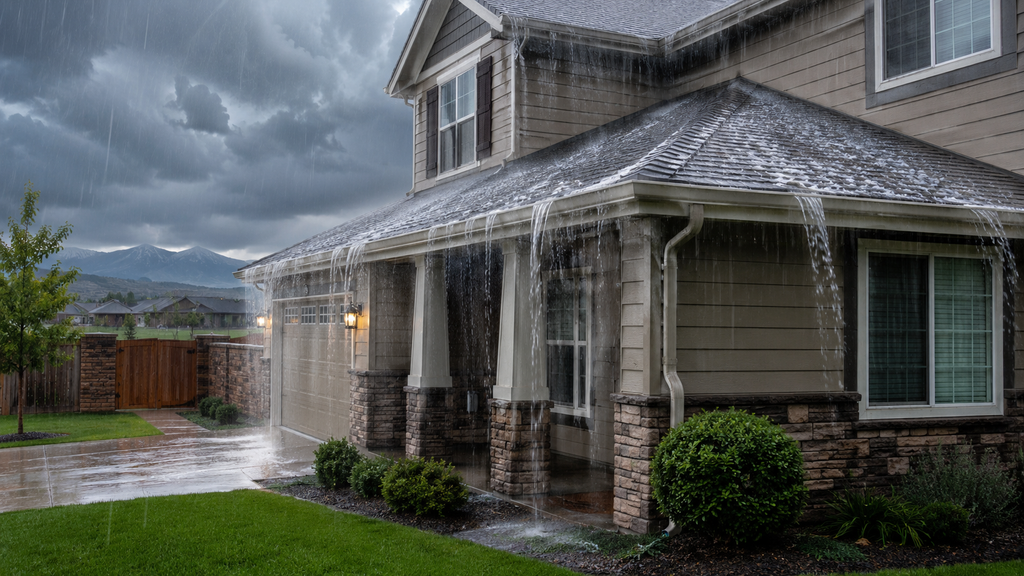
If you live anywhere along the Front Range, you didn’t need a forecast to know something was happening in mid-August. A run of monsoon storms parked itself over the region and let go. Denver picked up some of its heaviest rainfall of the year, flood advisories went up across the metro, and in a few spots the rain came down at one to two inches in half an hour. Denver International Airport was under a ground stop while it moved through — planes sitting on the tarmac because the sky wasn’t safe to fly into. Storms have kept rolling through the region in the weeks since.
Here’s the thing we keep running into on service calls: because there wasn’t much hail, a lot of homeowners have quietly filed this stretch of weather under “nothing to worry about.” Hail gets all the attention in Colorado, and for good reason. But heavy rain and the wind that drives it are their own kind of threat to a roof — and honestly, a sneakier one. Hail damage announces itself. Water damage takes its time.
Why heavy rain and wind are their own kind of roof threat
An asphalt shingle roof is a very good system for one specific job: moving water downhill, one overlapping layer at a time. What it is not built to do is hold back water that’s being pushed sideways, or uphill, or up underneath it. That’s exactly what a monsoon storm does.
Wind-driven rain gets in where straight-down rain never would. Rain in these storms doesn’t fall, it flies. Gusts push water underneath the bottom edge of shingles, up behind step flashing where the roof meets a wall, around chimneys, and along the seams of skylights. None of those areas leak in an ordinary afternoon shower. Under a 45 mph gust, they can.
Gusts lift and loosen shingles — often without breaking anything. Every shingle is held down by a sealant strip that bonds it to the one below. Wind can break that bond, lift the shingle, and set it right back down. From the ground it looks completely normal. It just isn’t sealed anymore. The damage from that storm doesn’t show up during that storm. It shows up during the next one.
Downpours overwhelm the drainage. Two inches of rain in thirty minutes is more water than a typical residential gutter system is sized to carry, especially if there’s any pine needle or shingle-granule buildup in there. When gutters back up, water pools at the eave, works under the first course of shingles, and spills behind the gutter into the fascia and soffit. If your gutters were already undersized or sagging, a storm like this is where you find out. (It’s one of the reasons we usually talk with people about whether their gutters need to be replaced along with the roof.)
Storms don’t create weak spots. They find the ones already there. Cracked pipe boots around plumbing vents, brittle sun-baked shingles, flashing that’s pulled loose, decking that never fully dried out from the last storm, or a roof that took cosmetic hail bruising a season or two ago and has been quietly thinning ever since. An older or already-stressed roof will hold up fine through a normal summer and then give way in one heavy night.
The leak you see today started days ago
This is the part that surprises people most, and it’s worth understanding before you go looking for the problem.
When water gets past the shingles, it doesn’t drop straight through to your ceiling. It hits the roof decking and then travels — running along the underside of the plywood, down the length of a rafter, sometimes fifteen or twenty feet across the attic — until it reaches a low point and finally drips. Which means the water stain on your hallway ceiling is very often nowhere near where the water actually got in. Homeowners who chase the stain end up fixing a perfectly good section of roof while the real entry point keeps letting water in.
There’s a time lag on top of that. Attic insulation soaks up the first several rounds of water before anything reaches the drywall. So the ceiling spot you notice on a Tuesday in September may well have started during that mid-August storm. By the time it’s visible, you may already be dealing with saturated insulation that’s lost most of its R-value, damp decking, and — in a hot August attic that’s suddenly humid — the beginnings of mold, which can take hold within a couple of days under the right conditions.
Invisible until it isn’t. That’s the whole problem with water.
Warning signs to look for after a heavy storm
You can check almost all of this from inside the house or standing in the yard. It takes about ten minutes.
- Water stains on ceilings or walls — especially new ones, or old ones that look like they’ve grown. Check closets and corners, not just the middle of rooms.
- Damp spots or a musty smell in the attic. Trust your nose here. Musty means moisture, even if you can’t see it.
- Shingle granules in the gutters or at the bottom of downspouts. A little is normal. A pile of what looks like coarse black sand is not.
- Any active dripping during or right after rain, even if it stops quickly.
- Gutters that clogged or overflowed during the storm, or that are now pulling away from the fascia.
- Daylight visible through the attic roof. If light gets in, water gets in.
- Missing, lifted, curled, or crooked shingles visible from the ground. Walk the perimeter of the house and look up at every slope.
Please don’t climb up there yourself. A wet or storm-loosened roof is genuinely dangerous, and walking on compromised shingles can turn a small repair into a much larger one. Every year people get badly hurt doing their own post-storm inspection. There’s nothing you can see from the roof that a professional can’t see for you, safely, for free.
What to do next
- Document what you can see inside. Photograph every stain, damp spot, and drip, and note the date. If a stain spreads over the following week, photograph it again. That timeline matters later if there’s a claim.
- Contain it, but don’t try to repair it. Put a bucket under an active drip, move furniture and anything valuable out from under it, and lay down a towel or tarp. Leave the roof itself alone — tarping and patching are jobs for someone with fall protection and the right materials.
- Get a professional inspection. Wind and water damage is often subtle: an unsealed shingle tab, a hairline split in a pipe boot, flashing that’s lifted a quarter inch. It’s the kind of thing that’s easy to miss and expensive to ignore. Our storm damage inspections include a full photo report of what we find, whether or not you end up hiring us.
- Then decide about insurance, with your roofer’s help. Not every leak is worth a claim, and a good contractor will tell you when it isn’t. But if there’s legitimate storm damage, having the documentation and someone who can talk to your adjuster on your behalf makes an enormous difference in how the claim goes.
One thing worth saying plainly: a roof inspection should be free. Anyone charging you to look at your roof after a storm has the incentive backwards. If you want the full walkthrough of how the first days after a storm should go, we’ve written it out in our Colorado hail storm emergency guide — most of it applies just as well to a wind and rain event.
A Colorado reminder: storm chasers don’t only chase hail
Every significant weather event in this state brings out-of-state crews into the neighborhood within days, and flooding rain counts. They knock doors, they mention the storm by name, and they’re gone by the time anything goes wrong.
It helps to know that Colorado has no statewide roofing license. Licensing is handled city by city, which means there’s no single credential to check and very little stopping someone from printing a yard sign and going to work. That’s not a reason to be paranoid. It is a reason to slow down.
A few things that should stop you cold:
- Pressure to sign today. A real roof problem will still be a real roof problem tomorrow. Urgency is a sales tactic, not a roofing condition.
- A “so we can inspect” form. Read anything you’re handed. Some of these are contracts that assign your insurance benefits or lock you into the company before you’ve seen a scope of work.
- An offer to “waive,” “cover,” or “eat” your deductible. This one is not a gray area. It’s illegal in Colorado and it’s a form of insurance fraud — and the homeowner who agrees to it is exposed too, not just the contractor.
This is something our owner, Ken Green, and our own Chris Simms went on FOX21 News to warn Colorado homeowners about directly, because we see the aftermath: a family with a two-year-old roof, no warranty anyone will honor, and a company that doesn’t answer the phone.
The good news is that this stuff is easy to screen for once you know what to ask. A contractor who intends to still be here in five years is happy to answer questions, show you a local address, and let you take your time. We put together a list of 10 questions to ask a roofing contractor before you sign — use it on us, too. We’d rather you ask.
Talk to a local team that isn’t going anywhere
Watchdog Roofing and Restoration is locally owned and based right here in Brighton, at 30 S. 7th Ave, Suite 400B. We work throughout Adams County and the surrounding Front Range — you can see the full list of communities we serve if you’re not sure whether we cover your neighborhood.
If this stretch of storms has you wondering about your roof, let us take a look. We’ll give you an honest assessment and a photo report of what we find. If your roof came through fine, we’ll tell you that and you’ll owe us nothing. No scare tactics, no pressure, no one showing up at your door the same afternoon.
Call Watchdog Roofing and Restoration at 720-235-8159 for a free, no-pressure roof inspection.